
Pentagon's New Reality: Competing for Technology in a Commercial-Driven Market
Perhaps the Pentagon isn't the best customer. But by responding to acquisitions reforms, regional economies can participate in a new wave of value creation.

In previous commentaries, I have noted that the Department of Defense is taking a more active role in the American technology market. However, even the Pentagon, with its nearly $1 trillion annual budget, is far from a dictatorial force in the American innovation economy. In previous generations, the Department of Defense stood at the front of the line to purchase new technologies. This is no longer the case. There is now too much innovation happening in the commercial sector, with new products entering the market before the Department of Defense can acquire them. The U.S. military is just one of many customers—including Big Tech and military adversaries—competing to be the first users of new technologies.
This somewhat unsettling reality has forced the U.S. military to purchase commercially available solutions more quickly and directly, and to guide suppliers in developing technologies with both military and commercial applications.
------
For much of the past three years, Ukrainian troops have logged onto Amazon and Alibaba, purchased unmanned aerial vehicles, and sent drones from their cardboard packages directly into combat. They have relied on low-orbit satellites owned and operated, and at least once shut off, by Elon Musk. And they continue deploying commercially available software, machine-learning algorithms, and facial-recognition technologies on the front lines.
We exist in an environment where the private sector is leading new frontiers of innovation. In the mid-1960s, the American federal government supported two-thirds of R&D done in the United States; that figure now hovers around 20 percent.
No doubt there are benefits to private-sector-led innovation, but as military forces rely on technologies available to private individuals, the very primacy of force that provides the foundation of nation-states is threatened.
During the Cold War, the U.S. military asserted technological dominance by acquiring bespoke technological solutions that far exceeded those possessed by any adversary or private company. No longer.
Today we see the national security challenges in the seas and the skies. The U.S. military is now charged with safeguarding shipping routes where pirates are threatening cargo ships with uncrewed underwater vessels (UUV). It has created an entirely new branch to safeguard commercial satellites that support our electrical grids, financial markets, and cellular networks. To safeguard our economic stability—both sustained and threatened by commercial innovations—the U.S. military must be among the first to procure and deploy commercial technologies.
For the American national security community to retain its technological leadership, solutions can come only through more actively participating in points of intersection where technologies are addressing defense and commercial needs. And regional economies stand to gain from building those points of intersection.
National strategic challenge
Perhaps the root cause of the Pentagon’s headaches is the simple reality that commercial sectors often present clearer demand signals with easily recognizable paths to sales and scalability. The U.S. military might be the greatest fighting force the world has ever known, but it has proven no match for the commercial sector’s market pull.
Take biotech, a sector that receives about $10 billion in research funding from the National Institute of Health each year. These dollars could very well lead to new discoveries in stronger and more lightweight body armor or sensors that can near-instantaneously recognize the presence of a chemical or biological weapon, but are instead often deployed to lead new pharmaceuticals or agents to enhance crop yields.
Of course, it’s not a bad thing that biotech startups are developing new and exciting innovations in sectors outside of the defense industrial base! However, if the American tech industry fails to engage meaningfully with the national security community, the U.S. military—arguably the linchpin of global stability since World War II—could soon be outmatched by adversaries with far more deliberate industrial policies.
To understand why so many new ventures turn away from, or never even consider turning toward, the national security industry, think like an entrepreneur. New ventures entering defense and commercial markets must follow different development milestones and seek different funding sources. Convenience factors are pulling new ventures away from the defense industrial base.
Startups entering commercial markets work to establish relationships with customers as soon as they can, rapidly innovating new products based on feedback. In contrast, new ventures entering the national security industry frequently respond to pre-established requirements and military specifications and develop products that meet the rigid needs of warfighters.
The regulatory environment for defense tech startups is far, far more onerous than those purely commercial ventures.
Startups looking to enter commercial markets and scale almost invariably turn to private, dilutive of capital. National security-focused startups very frequently turn to non-dilutive federal grants in the earliest stage of business development, then work their way up to sub-contracts with larger vendors. Perhaps this sounds more enticing to enter the national security industry, but private venture capital frequently provides a great deal more strategic autonomy and scalability than the grants-and-contracts development plans familiar within the national security industry.
Then there are the questions of government purpose rights and intellectual property controls.
Taken together, the Department of Defense has arguably earned a reputation as a really bad customer for new ventures. But there’s an effort afoot to change that.
Department of Defense actions
The U.S. military cannot reverse decades of technology diffusion or channel all American R&D into its acquisition pipelines. Instead, it must engage research institutions and commercial ventures to steer American R&D toward more rapidly addressing its challenges.
Mississippi Senator Roger Wicker and congressional allies are pushing a massive defense spending bill, the Fostering Reform and Government Efficiency in Defense (FoRGED) Act. The FoRGED Act is perhaps the most important piece of legislation in recent memory that nobody’s talking about. If signed into law, the act would add as much as $200 billion to annual defense spending and enact a series of reforms to allow for more non-traditional suppliers to work with the Department of Defense.
One particularly notable reform in the FoRGED Act is a provision requiring the Department of Defense to acquire commercially available products through more streamlined procurement methods. This change eliminates rules that have forced non-traditional vendors to stand up separate infrastructures to sell to the U.S. military. The legislation also empowers contracting officers—referred to as “portfolio acquisition executives”—to adjust contract schedules and requirements to more quickly and efficiently acquire new capabilities.
Understand that the defense industry has, for more than 30 years, been largely defined by specialists, namely five mega-contractors -- Lockheed Martin, Boeing, Raytheon, Northrop Grumman, and General Dynamics. This is arguably the legacy of a directive, made by Clinton Administration Secretary of Defense Les Aspin in 1993, to the Pentagon’s largest vendors to consolidate ahead of the looming Pentagon budget cuts. The “big five” has spent the last three decades pushing out commercial vendors.
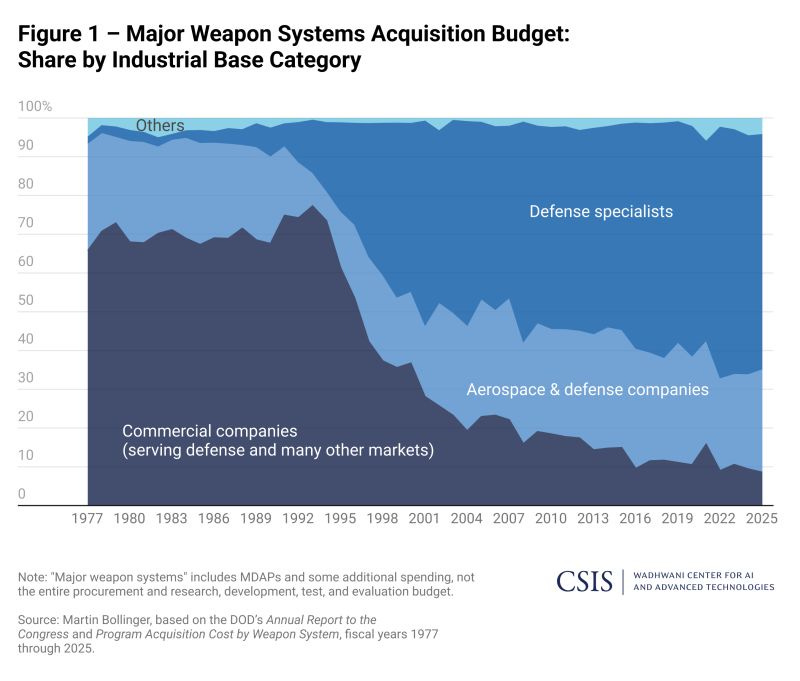
Now, taken together, the FoRGED Act could swing the doors wide open for new entrants into the American defense industrial base, introducing new competition to the national security industry long dominated by the “big five” — but only if research institutions and technology companies are willing to engage the national security industry.
That’s where regional economic leaders must help push technologies into the American defense industrial base.
Opportunity for regional economies
Regional economic leaders can work with the national security community to facilitate dual uses of technologies that create value for both military and commercial markets. That’s easier said than done.
The institutions and communities that drive the national security lab-to-market process are often culturally unfamiliar with one another, if downright adversarial, and operate with some inaccurate assumptions. Researchers frequently recoil at any suggestion that their work could aid in destruction, an unfortunate association with the national security industry in my judgement, but one that I know is prevalent and needs to be addressed. Capital investors view defense tech ventures as living under a valuation roof; this too is unfair – just three weeks ago, Anduril, the most celebrated of a new class of defense tech companies, signed a term sheet with a $28 billion valuation.
To drive more dual-use tech pathways, regional economic leaders (and my own organization) must demystify the national security sector and facilitate engagement early in the R&D process between researchers, new ventures, capital investors, and commercial and defense users.
We need to build tech development platforms with stakeholders across commercialization pathways seated at the table. These platforms would help license inventions from research laboratories — how to do this was the subject of a previous post — then engage corporate partners and investors in national security problem sets at early stages of R&D. As these platforms are solving national security challenges, with sufficient engagement with corporate partners, we could also understand and address the problems of commercial end users.
Specifically, these platforms could bring commercial and defense stakeholders into applications for federal grants, field tests, and bridge financings. They could support research that allows the national security community to act as an enabler of innovation for commercial and defense purposes — a great example is the Center for Defense Medicine in St. Louis — and not the sole end-user of new technologies. They could facilitate engagement with defense and commercial users in developing new products that meet the unique needs of both.
Perhaps these platforms could just help create an environment where the national security community is embraced by stakeholders who never before considered working with the Department of Defense.
There are several successful programs that help ventures engage with defense users and develop technologies to address national security challenges. With ongoing Department of Defense acquisition reforms, regional economic leaders have a unique opportunity to strengthen these programs by involving commercial partners, capital investors, and both commercial and defense end users more deeply and earlier in the R&D process.
Innovation in the commercial sector is thriving, but the national security community should play a key role in advancing technological frontiers. Regional economic leaders must also do their part to integrate national security professionals into innovation communities.